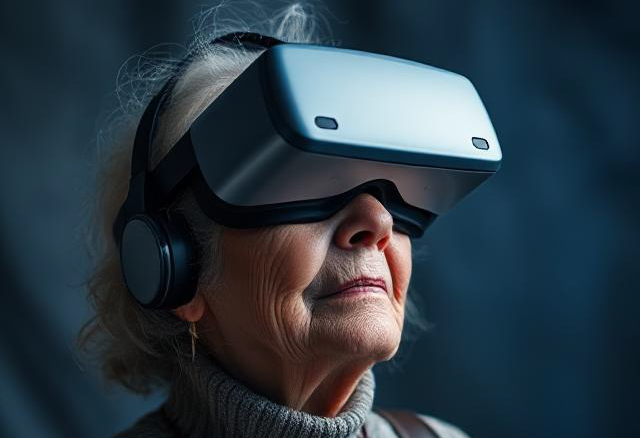
Falls are one of the leading causes of injury and hospitalization among older adults—and the risk goes up significantly when physical movement and mental tasks are combined. But exciting new research suggests that virtual reality (VR) training may help seniors move more confidently, even while multitasking.
A recent meta-analysis published in the Journal of NeuroEngineering and Rehabilitation looked at 21 clinical studies involving 935 older adults, exploring how VR training affects “dual-task” performance. Dual-tasking refers to doing a physical and cognitive task at the same time—like walking while talking or solving a mental puzzle. These everyday situations are often where falls happen.
🚶♂️ What the Study Found
The results were promising:
- Improved walking under pressure – Participants who trained using VR had better gait speed, stride length, and cadence while multitasking.
- Better mobility scores – On average, users completed the dual-task Timed Up-and-Go (TUG) test faster, indicating greater confidence and control.
- Significant gains for those with mild cognitive impairment or Parkinson’s – The benefits of VR were even more pronounced for individuals facing neurodegenerative conditions.
While the VR didn’t significantly improve reaction time during cognitive tasks, the motor improvements were enough to meaningfully reduce fall risk.
🧪 What Makes VR So Effective?
VR creates immersive environments that challenge the brain and body at the same time. These virtual spaces often require quick thinking, visual focus, and controlled movement—all while remaining fun and engaging. In this way, VR combines physical therapy with cognitive training, helping the brain learn to manage multiple tasks more efficiently.
✅ How to Maximize the Benefits
According to the research, the most effective VR training programs followed this formula:
- At least 1 hour per week
- Conducted over 4 or more weeks
- With 3–5 sessions per week
Whether it’s virtual grocery shopping, obstacle courses, or memory games that require movement, these kinds of experiences seem to support better coordination, balance, and mental alertness.
🧓 A Game-Changer for Aging Adults
This study is a powerful reminder that technology—especially VR—has the potential to revolutionize how we support mobility, safety, and independence in older adults. For families, senior care professionals, and rehab specialists, this opens the door to new ways of preventing falls and enhancing quality of life.
Link to the article: https://jneuroengrehab.biomedcentral.com/articles/10.1186/s12984-025-01675-z
 English